The Quiet Power of Moss: What Soft Things Teach Us About Survival

Some things don’t bloom. They cling.

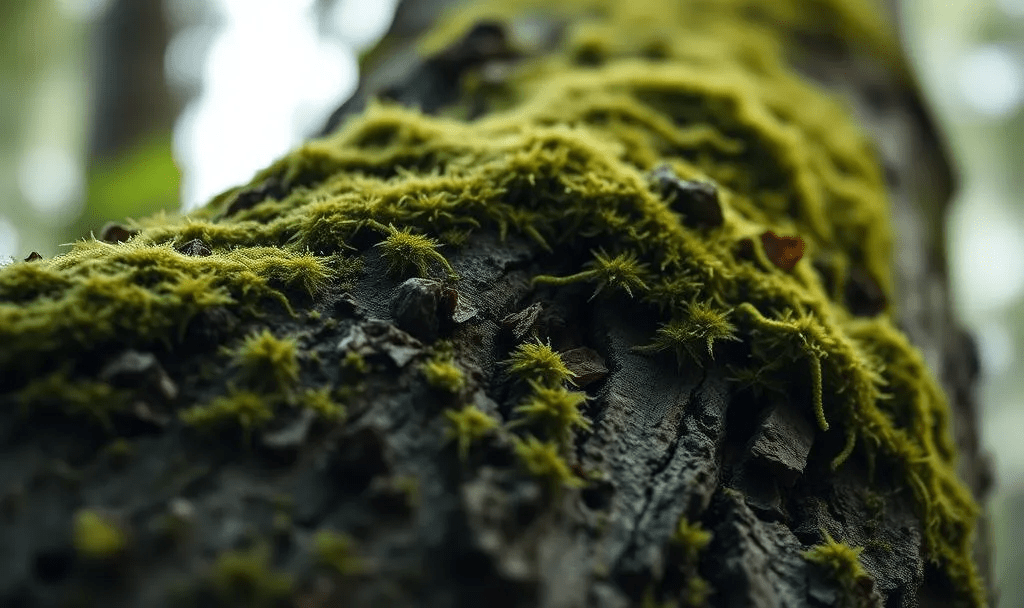
Moss has no flashy petals, no towering stems, no fragrance to lure you close. But once you start noticing it—curling over stones, softening the bark of old trees, thriving in the forgotten corners of forests—it’s hard to unsee.

I first started paying attention to moss during a walk in the woods after a therapy session. I was hollowed out, emotionally cracked open, trying to make sense of how to live in a world that hadn’t always been kind to me. The trees didn’t say much that day. But the moss? The moss felt like it had something to say.

Moss thrives where other things can’t.In the natural world, moss is one of the oldest forms of plant life—resilient, humble, and quietly persistent. It doesn’t need deep roots. It doesn’t require perfect conditions. It survives where others can’t: on rocks, in shade, and with very little nourishment.

There’s something deeply comforting about that.

I think about the parts of me that survived the hard years—not because they were strong in the traditional sense, but because they learned how to stay soft. The parts that clung to scraps of kindness, that made something green from very little. That’s moss energy. It’s not about pushing through. It’s about adapting, absorbing, and continuing.

Moss is often overlooked. People step on it. Brush it aside. Sometimes we do that to ourselves, too. Especially when we don’t fit the mold of what strength is supposed to look like—loud, busy, linear, ambitious.

But moss reminds me that there’s power in softness. Power in choosing quiet. In being the one who holds the emotional texture of a room without demanding to be the center of it.

If you’ve ever felt like the background friend, the one who supports while others shine—know that moss is like you. And the forest wouldn’t be the same without it.

There’s a therapeutic lesson in moss care: it teaches presence. Moss doesn’t grow quickly. It doesn’t chase sunlight. It teaches you to slow down. To notice dampness. Texture. The way light moves through the trees.

Lately, I’ve been trying to live more like moss—choosing rest over hustle, curiosity over control. When my nervous system starts to spike, I try to remember that the most ancient forms of life are also the most gentle. They don’t shout. They whisper. And they’re still here.

If you’re in a season where blooming feels impossible, look to moss. It doesn’t rise above. It holds tight. It makes beauty out of broken places. That, too, is survival.

Maybe the softest things aren’t weak. Maybe they’re just the wisest.

The Dark Waters of the Mind: How Nightmares Mirror the Element of Water

Nightmares have haunted human sleep since the beginning of time. While they may seem like senseless, terrifying disruptions, these nocturnal episodes often hold deep symbolic meaning. One powerful lens through which to understand nightmares is by examining their connection to the natural element of water—an ancient, shape-shifting force that reflects our unconscious mind.

Water, by nature, is emotional, elusive, and deeply symbolic. It cleanses and destroys, gives life and threatens to drown it. Likewise, nightmares can be both cathartic and terrifying, often arising from the depths of our subconscious to signal something unresolved. They may manifest as drowning, tidal waves, murky lakes, or rainstorms—each carrying its own psychological weight. But even beyond the dream content itself, water as an element offers a profound metaphor for the nightmare experience.

Nightmares tend to surge during periods of high emotional intensity—grief, anxiety, trauma, or major life changes. In the same way a flood breaks the levees, nightmares break through the barriers of our waking defenses. Just as water overflows when a container is too full, the psyche releases excess emotional pressure through dreams. Nightmares aren’t random—they are the emotional floodwaters of the mind, seeking release when we can no longer contain our feelings by day.

In Jungian psychology, water is often seen as a symbol of the unconscious. When it appears in dreams—especially as turbulent, overwhelming, or threatening—it can suggest that powerful emotional material is trying to surface. Nightmares can be seen as the soul’s attempt to purge or process these deep inner currents.

On the surface, nightmares seem chaotic, but beneath them lie meaningful patterns. Calm water might look harmless until a riptide pulls you under. Nightmares often work the same way—they may begin with a familiar setting, only to twist suddenly into something frightening. That shift mirrors the deceptive calm of our waking lives when, under the surface, trauma or anxiety is silently churning.

Recurring nightmares are like a warning buoy bobbing in open sea—something wants your attention. Whether you’re dreaming of being chased, trapped underwater, or watching a tsunami rise in the distance, the metaphor often points toward emotional overwhelm, unresolved memories, or fears too long ignored.

Though water can devastate, it also transforms. Rivers erode rock. Rain nourishes. The ocean holds mystery but also rhythm and renewal. Similarly, nightmares—though painful—can catalyze healing. They can guide us to repressed truths or highlight patterns we’re avoiding. When faced consciously, nightmares become messengers rather than enemies.

Therapists often encourage clients to record nightmares and work with the imagery, asking: What is the water trying to show me? What’s beneath the surface? Approaching nightmares with curiosity rather than fear allows the psyche to integrate the message. Just as facing the ocean teaches respect and caution, facing our inner waters can offer profound self-understanding.

Water connects all living things. It moves through rivers, clouds, and veins. It remembers. Similarly, some nightmares feel older than our personal lives—dreams of drowning, being pulled by unseen hands, or finding yourself lost at sea. These may speak to ancestral trauma, collective fear, or generational memory.

Carl Jung believed water in dreams often symbolized the collective unconscious—a shared psychic reservoir of human experience. Nightmares from this realm may not make immediate sense, but they often carry archetypal imagery that taps into primal fears. In this way, water becomes not just a personal symbol, but a bridge to a larger, more mysterious truth.

So how do we calm the waters of the mind? Grounding practices like journaling, meditation, breath work, and therapy can help bring awareness to what’s stirring beneath the surface. Keeping a dream journal by the bed creates space for the nightmares to land—to be seen, understood, and softened.

Remember: water doesn’t respond to force. It responds to presence. The same is true for nightmares. When met with patience and attention, they begin to shift. Sometimes the waves crash harder before they recede—but eventually, clarity comes. The storm passes. And the water, once feared, becomes a mirror.

Nightmares, like water, reflect our emotional landscape. They are neither punishment nor prophecy, but a natural response to the turbulence we carry within. By viewing nightmares through the lens of water—fluid, reflective, and deep—we gain a more compassionate understanding of their purpose. They are not here to drown us. They are here to cleanse, reveal, and transform.

Rooted and Uprooted: What Trees Teach Us About Human Change

There’s a skinny Beech tree about 10 feet tall outside my window that I hastily transplanted last night. I dug it up from a shaded patch of woods surrounded by 70 foot mature Maple and Oak trees. It was at my property that’s 15 minutes away from my house.

My husband got Persimmon tree starters from a neighbor and he wanted to plant a grove at the property. I saw the established Beech tree and knew I had to have it in our backyard. We built a house two years ago and there are no mature trees, which hurts my nature-loving heart.

My dad worked in the veneer industry and I spent my life observing trees. It’s my safe place, my home. He taught me that the root ball is the most important part of digging up a tree if you want it to survive. He taught me that you should dig up a new tree with a diameter of at least three to five feet in order to preserve the root ball. Well, the Spring sun was getting ready to set in an hour and my husband wanted to test out his new boomerang that his sister brought home from Australia.

Since the tree cost nothing and we have hundreds of them, I told him to dig it up quickly, so we only dug a one to two foot root ball. My dad was probably rolling over in his grave.

We got on the four wheeler hauling our ten foot tree and threw it in the pond so the roots didn’t dry out until we were ready to leave after his failed attempts at getting the boomerang to circle back.

We rushed home and immediately dug the hole. It was pure clay, which isn’t good. We dug it up from a sandy, loamy soil. Tree roots need air pockets to survive. I pushed it into the ground and smothered it in the clay, watering it with a rooting hormone. So much of me feels like it won’t take, but I will try everything to get it to survive because if I love something enough it will work out, right?

It looks beautiful in the morning light, but the leaves look droopy upon closer inspection. My heart sunk. That image won’t leave me because I’ve felt like that tree—cut off from what was familiar, stunned by the cold air of change, and unsure whether I’d survive the move.

Transplanting, whether of trees or of people, isn’t just a moment. It’s a season. One full of pain, patience, and quiet becoming.

As trees prepare for transplant, change begins long before the move. A tree must be pruned and roots partially loosened. The timing must be right—the soil prepared. You don’t just rip something out of the ground and expect it to thrive.

We’re the same. We know when something no longer fits—a relationship, a job, a version of ourselves—but leaving takes more than awareness. It takes readiness. When we rush, we tear something vital. When we delay too long, we risk shrinking in place. The body knows when it’s time and learning to listen is part of the work.

Even in perfect conditions, a tree experiences shock because of the root disturbance. It stops absorbing nutrients. It drops leaves. From the outside, it looks like it’s dying.

So do we.

When we leave the known behind, even for something better, we often fall apart before we rebuild. There’s grief, guilt, and that whisper of, “Maybe I made a mistake.” But that isn’t failure. It’s a natural part of the process. The old roots have been severed. The new ones aren’t established yet. It’s okay to feel lost in between.

Replanting requires the right soil. Where the tree lands matters. It needs sunlight, good drainage, and protection from wind. Without the right conditions, the transplant won’t take. I made all of those mistakes with my new Beech tree because I had no time or patience. I thought I could wing it on a hope and a prayer.

Humans need nourishing environments, too. Safe people. Quiet mornings. Gentle structure. You don’t owe anyone speed. You don’t need to prove your worth by blooming fast. Healing asks for presence, not performance.

Adaptation happens underground. For a while, nothing seems to happen. The branches stay bare. The growth is invisible. But underground, the roots are reaching, rebuilding, and testing the new soil.

We live this too. We think we’re stuck, but really we’re re-rooting. What looks like stillness is often transformation in disguise.

Eventually, if conditions are right, the tree adapts and thrives in it’s new location. The roots grow deeper. The trunk grows stronger. The stress of the move becomes a memory as the bloom returns.

And maybe, in time, you will feel that too—that this new place was not just an escape, but an arrival. You will feel that you are not just surviving, but thriving and that you’re not who you were before the transplant happened.

If you’re in a season of uprooting, know this: there is nothing wrong with you. This discomfort is not a mistake. It’s your system adjusting. Keep resting. Keep reaching. Let the roots take hold.

The bloom will come.

Do Flowers Have Feelings?

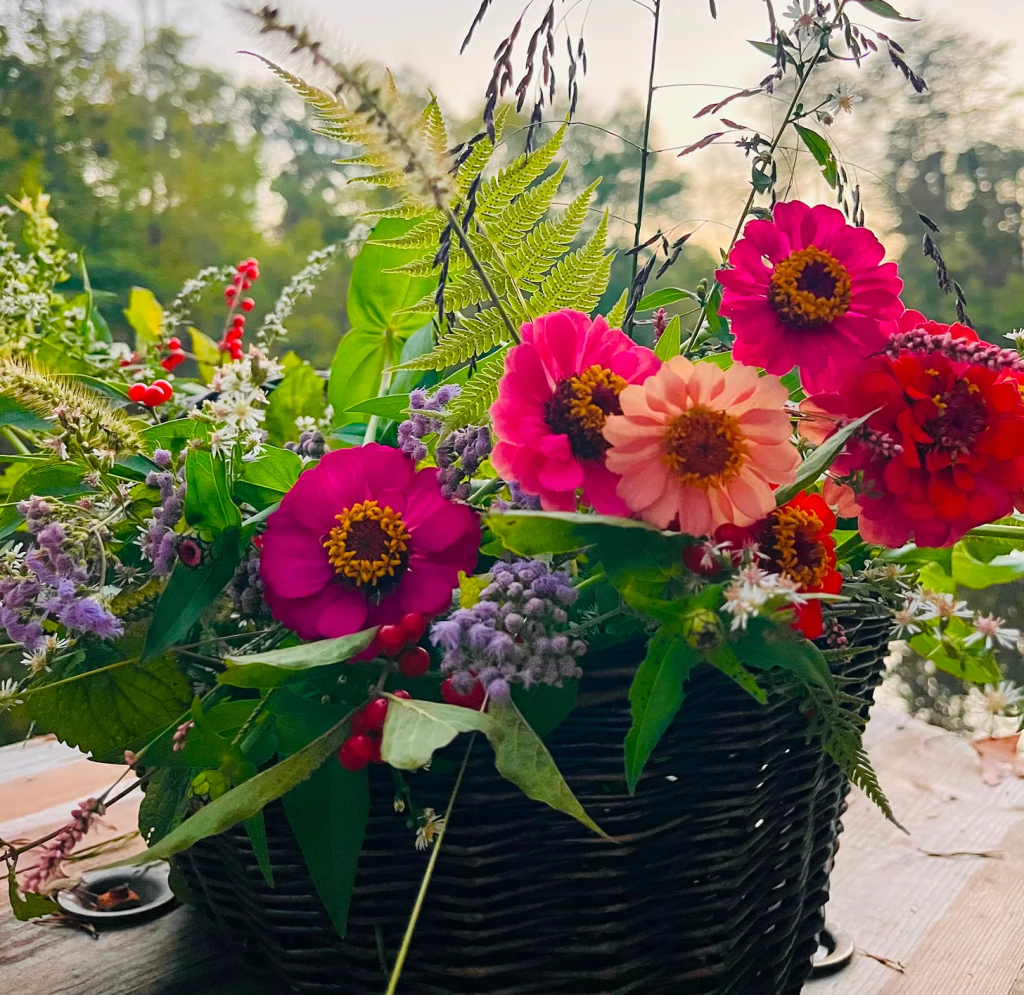
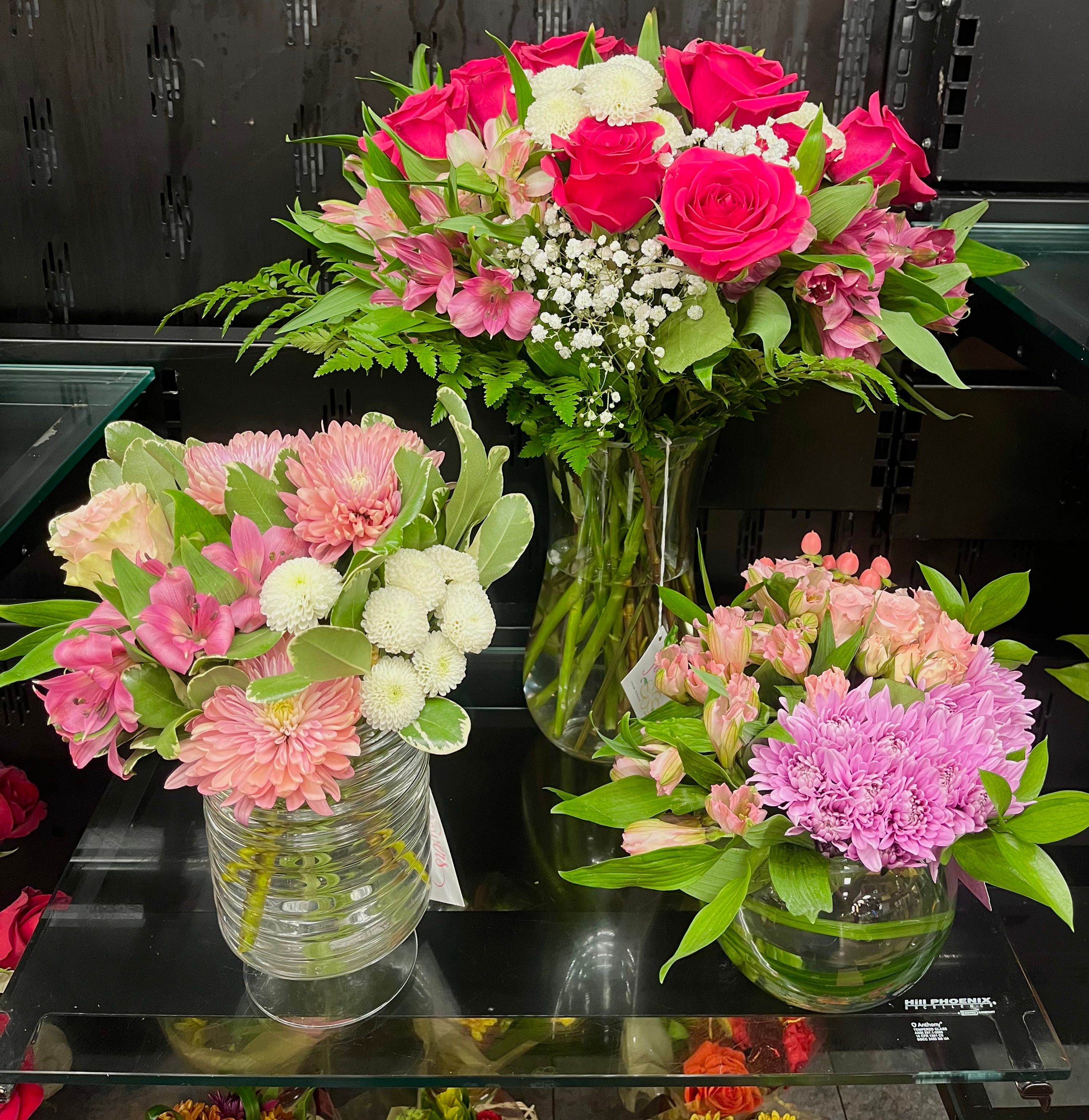
This basket of flowers was harvested from my own land. I had unlimited textures and colors to choose from. I picked grasses, flowers, berries, ferns, and ground cover. It was all free! The land hardly noticed I clipped anything. The bees kept gathering nectar below me, knowing I wasn’t threatening their food source. The bouquet turned out gorgeous! I would have easily had to pay over $100 for it at a Florist’s shop.

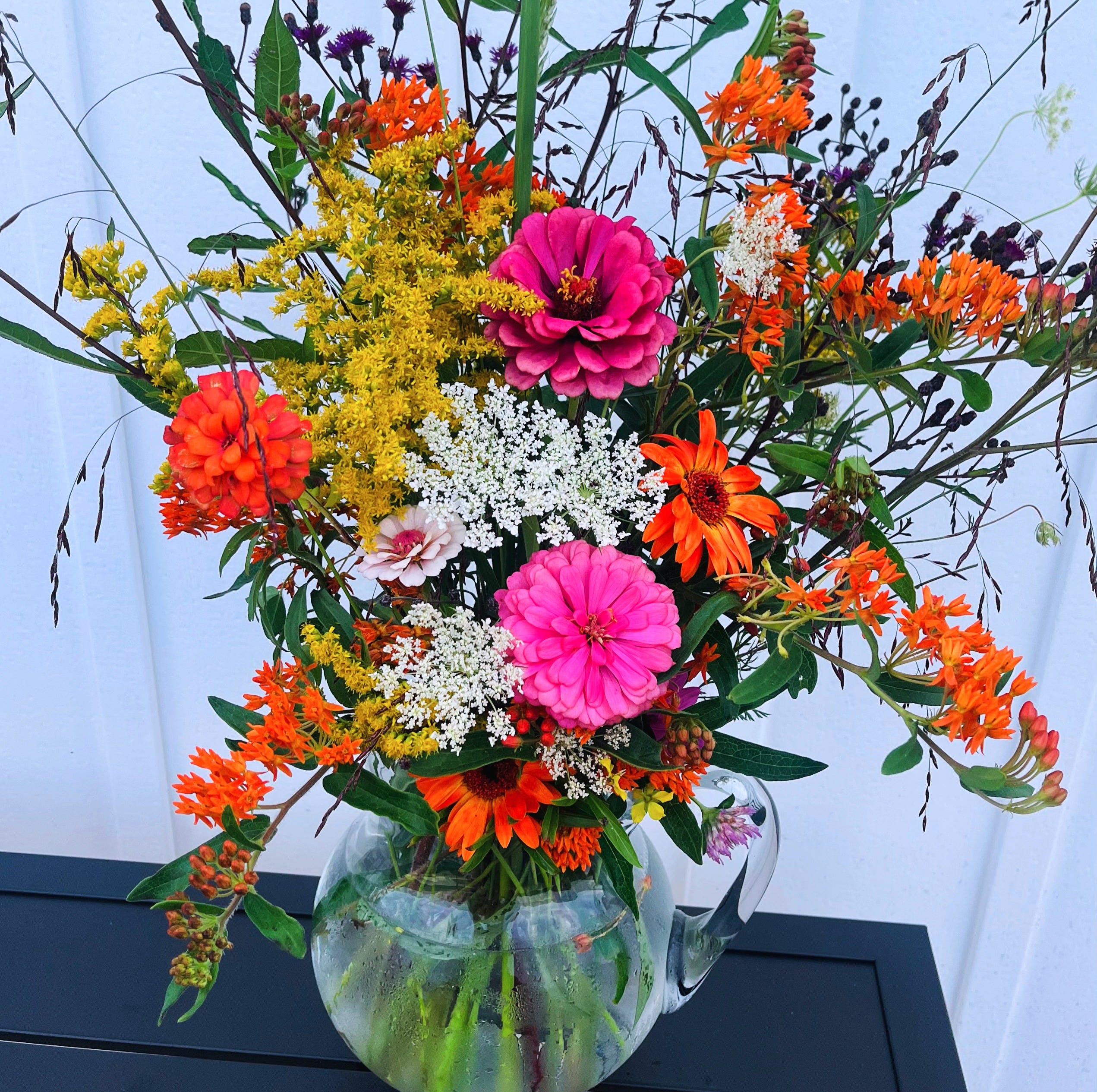
Another funky, free arrangement!

But do you see how I have to keep them outside on my porch? I do not use pesticides, and flowers come with tons of bugs. I don’t dare bring them inside because the pests will certainly take over my home and extensive houseplant collection. My wild bouquets didn’t last as long in the summer heat as they would indoors, but they made me just as happy. I changed the water every other day and would get at least a week out them, as opposed to the two or three weeks I would get from the pesticide ridden florist flowers.

I was employed as a Florist for four months. It was eye opening. It is not a sustainable or eco-friendly industry. The amount of chemicals and plastic waste that goes into it is sickening! I could not ethically work there – for the planet or my own health.

I also noticed a personality difference between the flowers. Could it be my own projection? Absolutely. But could it be real? Possibly…

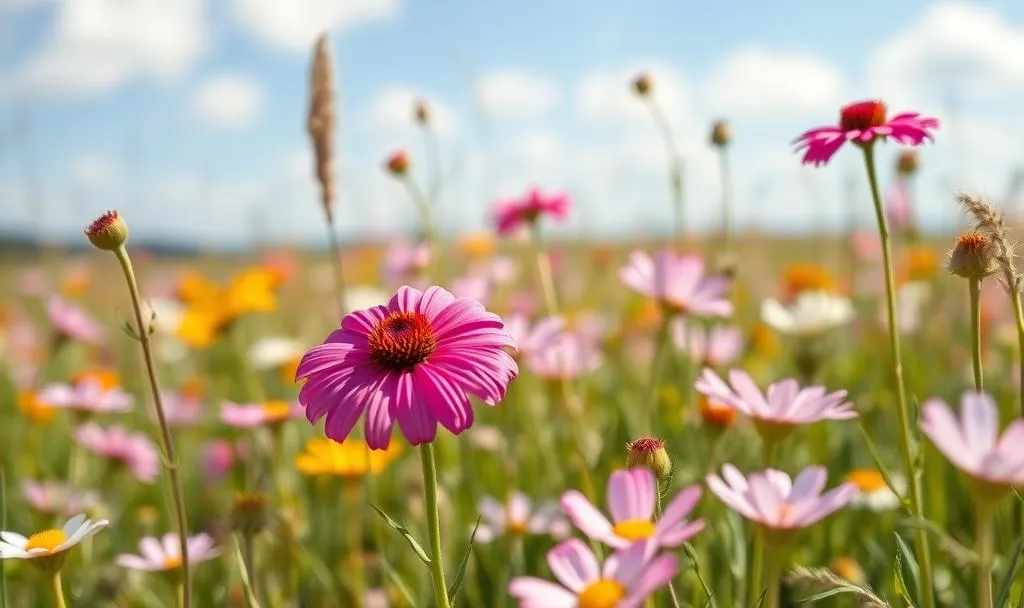
There’s something primal about harvesting wildflowers. I never felt bad cutting stems because I left 200+ others in the field. I knew the others were going to continue supporting the ecosystem and that nature was happy to provide me with a beautiful bouquet for a week.

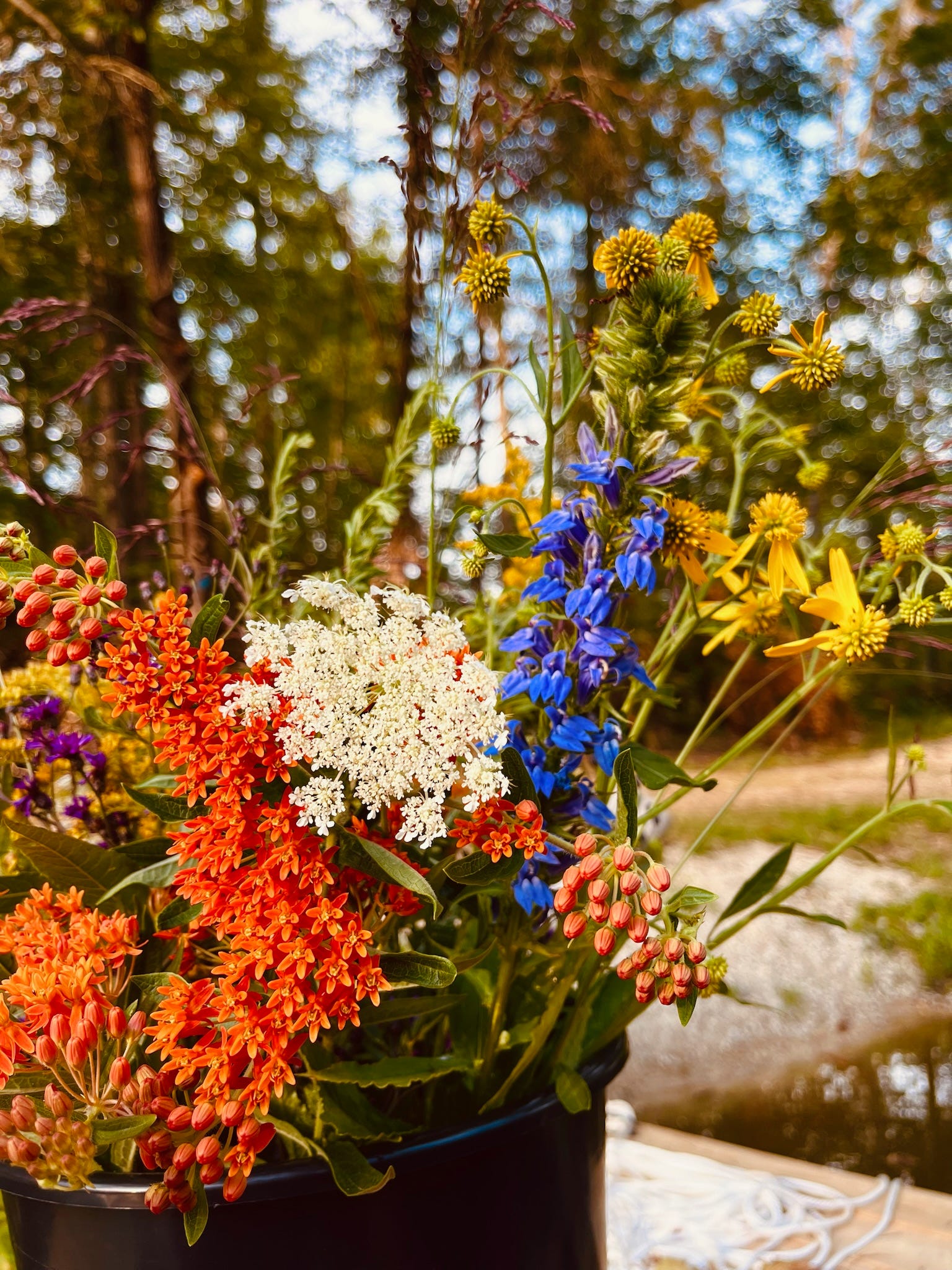
August Finds 2024

At the floral shop, the flowers I would receive in cardboard boxes from a Continent away seemed devoid of life or character. They are shipped in thin plastic buckets with minimal water to prevent spillage. The bucket is then placed inside of a plastic trash bag to prevent the inevitable spilt chemical water from ruining the cardboard shipping box. Then they are taped up and slapped with plastic straps on pallets. It was an ordeal to unload each box! I would get around 75+ boxes each week.

A lot of them are moldy from the dark, damp unpredictable shipping environments. Most come in dehydrated and sad looking. But what can we expect? I live in Midwest USA and our supplier shipped from Ecuador and Columbia.

Can you imagine growing strong in sunshine-filled fields on your mother plant in South America then being shrouded and crammed into dark, damp boxes for FOUR DAYS, then expected to live in who knows what kind of environment for two more weeks?

The longer I was in the industry, the more painful it became for me. My wildflowers that grow naturally are treated with respect and reverence. I don’t rush to cut them and they never travel more than ten miles back to my house. Each time I look at my personal arrangement, I picture the exact location I picked it from…a smile naturally forming on my lips. When they die, I throw them on my compost pile and they become useful to the Earth again. There is no waste in wildflower picking.

Florist Shop

However – not everyone has access to acres of wildflowers, or the ability to form an aesthetically pleasing bouquet (it’s so much harder than it looks). Special events don’t seem complete or luxurious without flowers. There’s no better feeling than getting fresh flowers in times of celebration, grieving, or “just because.” It’s a timeless tradition that aims to bring nature into our lives to remind us that life is worth living, we’re not alone, and that Mother Earth will provide for us. She compliments our sterile homes and offices with her wild beauty and fragrant blooms.

Maybe we’ve become too advanced as a society? If you think about the logistics of it all, the floral industry is impressive. I was able to receive fresh flowers in Midwest USA that were cut in South America 2-4 days before. That’s insane! We should feel proud of our technological advances. It used to take days to travel one state on horseback 200 years ago. Now we can fly 3,000 miles in less than six hours.

But just because we *can* doesn’t mean we *should.* Maybe it’s time to take a step back and listen to the Earth? She is screaming in pain. We are overusing and abusing her resources. She can’t handle our pace. She deserves respect and rest too.

I think the world would become a much healthier place if we realized all living things have feelings. I don’t think flowers have the complex emotions we do, but I do think the environment does as a whole. When massive fields are being abused for one specific crop/flower, they deteriorate. Nutrients are depleted from the soil; soil erosion then becomes an issue, which continues on in a domino effect.

What’s something you’ve noticed that has been taken advantage of because of technological advances and is contributing to the deterioration of the Earth?

Starting Over

Spring, a time of renewal and growth. It’s about new beginnings and rejuvenation. As I’ve gotten older, I look to nature to sync up my natural rhythm. I stopped caring about climbing the corporate ladder and the never ending “go go go.” I change with the seasons and it’s set me up for a stable, full life.

In summer, I ramp up. I garden, exercise, and become much more social. There’s graduations, weddings, and cook outs. I take it all in and breathe deeply. I’m more positive and productive. I savor the beauty of the never setting sun, fresh fruit, full trees, and gorgeous blooms. I don’t need as much sleep and feel naturally light.

In fall, I’m thankful. I start to slow my roll. I take in the last moments of the glowing leaves, shining bright oranges, deep reds, and soft yellows. I love the chunky sweaters and warm apple cider. I get excited about spooky decorations and the cheerful kids wanting to collect as much candy as possible. I think deeply about what I want to let go and what I need to heal as the year wraps up.

It sounds easy, but changing mental states can feel scary. It’s hard not operating the same everyday, but I know the burn out feels worse. The last few years of letting go of perfection and over-performing have been humbling to say the least. I feel judgment from the majority of people who don’t seem to subscribe to seasonal adjustments. But when I let go of perceptions and look to nature, I feel whole and on track.

This year hit differently though. I was hit with two major medical setbacks. I was diagnosed with an autoimmune disorder that prevents me from being in the scorching sun and I suffered a severe foot injury that involved surgery and six months of rehab, four of which were couch bound. It was horrific. I’m still not back to my pre-injury self. I don’t know if I ever will be either.

I’m ready for my springtime renewal. I want to start seeds and mow the newly green grass. I want to hike with my dog in the spring air and feel fullness. I want to set new goals and start working towards them…but I can’t. I’m not physically able. It’s left me scared and confused. I still feel like I’m in the dead of winter.

I thought I would be better by now. I thought I would be so much further than I am. I worry that I’m never going to get my stamina back. I feel lost and out of tune. This is the first time my body isn’t changing with the natural seasons and I don’t know what to do about it. I look to the trees and flowers and feel bitterness. I’m jealous of their effortless, natural transformation. I long for easy growth and seamless transitions, but they’re not coming.

I wish I could say that I choose positivity and hope, but most days negative feelings wash over me. I want to hide and stay in the darkness. I feel unsettled with the longer days and changing into pajamas at 5pm still. I see my neighborhood coming alive again. Kids play basketball and ride bikes, and all I feel is fury. I can’t believe I took my physical health for granted. Being able-bodied my entire life, I didn’t know the struggles people with disabilities go through. It’s so much harder to live and it’s as if no one else lays witness to it. It’s an internal struggle that I have to face alone.

I pray that I can have the fortitude to keep moving forward. I hope my attitude adjusts with the changing season. I want my jealously to wane. Until then, I will continue to sit in the darkness and respect myself as I am today. I might not be blooming, but I will be one day. This might be a year of winter and I’m going to have to let that be okay. I know I can’t be the only one going through this. Instead of looking to nature for camaraderie, maybe it’s time to look towards other humans who are also experiencing a long winter.

Can you relate?

The Peace Lily and the Power of Stillness

A Lesson in Quiet Resilience

If you’ve ever been to a funeral, you know exactly what a Peace Lily is. It represents the rebirth of the departed soul from the physical world to a more peaceful place. They’re striking with the dark green leaves and bright white blooms. I have been to many houses that have that single houseplant and they speak reverently about who passed and how they’ll never get rid of it or let it die.

I love Peace Lilies. They’re upfront about their needs. They love bright, but indirect, light. It throws a tantrum when it’s distressed by dramatically drooping its leaves. They reward us with graceful white blooms when we care for them just so. It’s imperative to create a relationship with this plant. They’re like an easy baby; as long as you follow a schedule and give it what it asks for, it’s happy.

I think this plant is a wise teacher. It draws parallels from the plant world and our lives. It reminds us that humans need gentle environments, emotional attunement, and patience in personal growth too.

Sensitivity isn’t a weakness. The Peace Lily thrives in soft light and wilts when neglected, much like sensitive people who need mindful surroundings to flourish. Instead of labeling sensitivity as fragility, this plant shows us it’s a strength that demands deeper care and understanding.

A prominent lesson is that signs are subtle, but honest. A peace lily doesn’t scream when it needs water—it droops. Humans, too, often give quiet signs of burnout, sadness, or stress. Learning to recognize these subtle cues in ourselves and others is a practice in empathy and emotional intelligence.

I’m a natural empath and people pleaser. I can be the Giving Tree. However, I have learned my limits. I used to burn out by giving so much of myself to others that I didn’t have anything left. I get a short fuse when I’m emotionally depleted. I start resenting people and start to isolate. It took a long time for me to look inside of myself and set boundaries. It felt awkward telling people no and I was ridden with guilt for a couple years. However, I have noticed that I’m much happier now that I learned to strike balance.

I recognized that blooming takes time. The white bloom doesn’t appear overnight. It comes only with sustained attention and the right conditions. Just like healing, creativity, or growth—it can’t be forced. You can’t rush a Peace Lily into flowering, nor can you rush your own transformation.

I started to understand that I need to take care of myself first to be useful to others. If I’m operating from a place of obligation, it doesn’t feel good to me or the people I love. When I’m attending to my needs, I naturally want to help others bloom. I feel a lightness about me when the conditions are right. I can’t operate at full capacity 24/7. Just like plants need darkness to recharge, I do too.

The peace lily is a cleanser of air and calmer of spaces. Peace Lilies are natural air purifiers. They silently cleanse what’s unseen—just like how certain people calm rooms with their presence, or how stillness itself can detoxify the chaos in our lives.

In a world that prizes speed, noise, and toughness, the Peace Lily invites us to embrace softness, slowness, and care. It reminds us that peace isn’t passive—it’s a powerful, living thing that must be nurtured.

Freshwater Jellyfish Freeze Time

Did you know there are freshwater jellyfish that float around in Midwestern ponds? I didn’t. I’ll never forget the day I discovered it. I was floating in our pond and the sun was beating down on me in a brutally soothing way. I thought I felt something swim past my hand and opened my eyes to the horror of hundreds of JELLYFISH surrounding me!

I couldn’t figure out if I was having a heat stroke or about to die by a thousand stings, so I froze. They surrounded my legs and torso, tickling me, but did not sting. They were the size of nickels. My mind was shooting reels of people in Florida being stung by venomous box jellyfish and their flesh falling off. I remained still until they disappeared, then I swam like hell to shore when they were out of sight. I had to find my husband!

He told me I was full of it. He said he never heard of such a thing. Upon further investigation on Google, I was pleased to find out that freshwater jellyfish do exist and I wasn’t having a stroke. We were blown away. We called the DNR office and asked about them. They said they’re quite rare because “the conditions must be just right.” He kept stressing that point. We have a natural spring fed pond that is over an acre in size and hasn’t been disturbed in decades. It’s as clear as a bottle of water.

Nature has done it’s job in creating a perfectly balanced aquatic ecosystem. The Peach Blossom Jellyfish arrive every August and stay for a couple months to eat the zooplankton. They surface and swarm us in the late afternoon and around sunset on clear, warm days. It is probably our families greatest treasure on the land. We get extended family and friends to come down and experience this rare treat.

August and September have become the most influential months in my life because of the Peaches. It’s a time where I’m tired of long, hot summer days. Every year I wait in anticipation of the first day where I dip in the pond to cool off and my see-through friends float up to greet me. It brings a childlike squeal and massive smile to my face each time. It’s better than Christmas, because I never know when, or even IF, they’re going to come. Their conditions are fragile and they’ve been accustomed to no one being around for decades. We’ve only inhabited the land for four years now. Will our frequent swims with sunscreen, removing dead trees, and adding a dock contribute to their demise?

It reminds me to stay present with them. Each time I see them could be the very last time. I want to memorize how their translucent color looks magical over my bronze skin, a perfect backdrop to analyze all their tiny tentacles. I notice how I’m equally grossed out and enamored with how it feels as they glide across my skin by the dozens. They capture my full attention with their various sizes. The babies that are fully formed, yet hardly the size of a pin head, melt my heart. I wade around with them for hours.

My daily struggles and worries have no place when I’m with the Peaches. My stresses will always be available when I need access to them. They don’t discriminate or require any special conditions. They can be put on the back burner.

August and September are months where I actively choose to stay present with Mother Nature. I want to soak in every detail before the darker months begin to hit. I naturally notice how the sun is lower on the horizon and closer to the tree line. I see the leaves slightly start to shrivel in preparation for their big fall. I notice the animals coming out earlier in the evening. I notice the Peaches enjoying the warmth of the water 15 feet off the bank. I see the wildflowers in full bloom, putting out their all before it’s time to go to seed. I see the fox in his burrow.

It reminds me that I am a part of nature too. How should my behavior be changing with the upcoming season? Should the fact that I have a waterproof home with heat/air conditioning and electrical lighting really require me to function at the same capacity year round and reject Mother Nature’s natural cycle changes? If I really think about it, that sounds like a recipe for disaster. It sounds like a surefire way to get burnt out, sick, angry, exhausted, and dysregulated.

Lavender Remedies for the Soul

I was hiding in the cold garage, berating myself for smoking. It’s a naughty habit that I only succumb to in times of immense stress. I was hurling the most vile insults at myself. I felt like I couldn’t breathe as the panic started to hit my chest. The plumes of smoke became too dense to find oxygen.

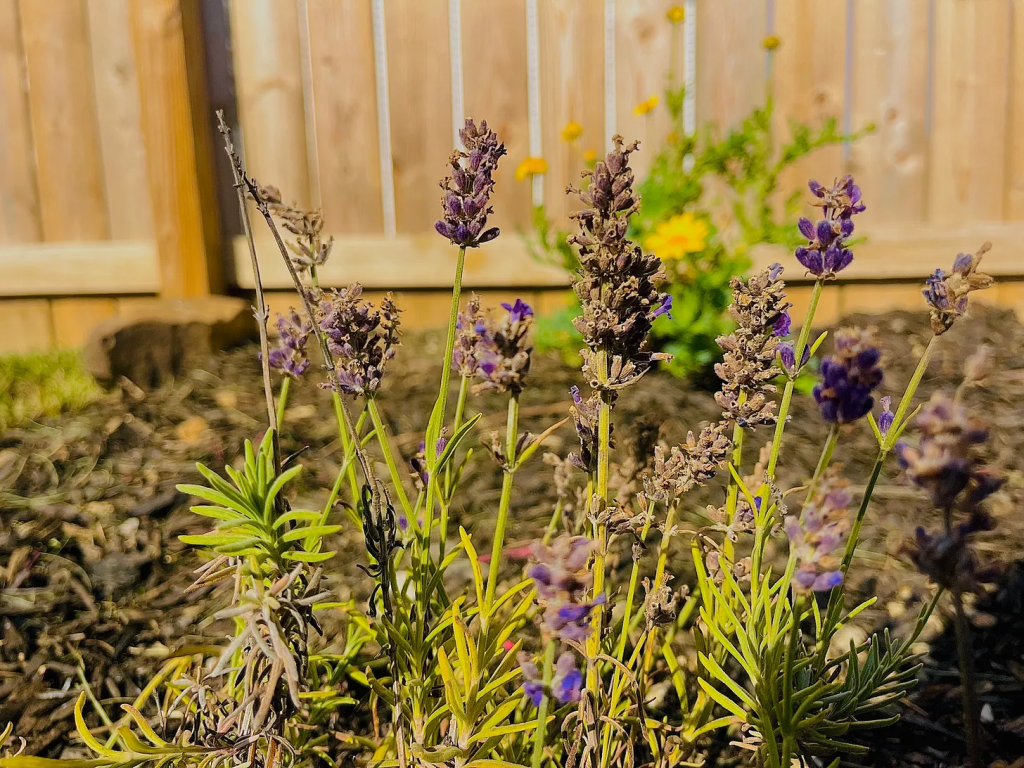
Even though I’m allergic to the sun, I ran outside unprotected. I needed fresh air to level my head out ASAP. I walked to my dinky garden, which never got finished since I was in the throes of figuring out my blistering skin disease this summer. There were only a few wildflowers that were strong enough to survive complete neglect and clay soil that had never been amended. I couldn’t help but be embarrassed of it. It was another reminder of my failures.

I hung my head low in defeat. A bit of royal purple caught my eye. It was the last remnants of the sugary sweet butterfly bush flowers and lavender. They were releasing a mesmerizing scent. I stopped and picked the mostly dead flowers to enjoy before the freeze.

The scent soothed my angry heart.

As I took deep breaths of nature’s perfume in, the negative self-talk was pushed out.

My mind stopped racing. I was able to feel the warm Fall breeze blowing my freshly cut hair. I noticed how comfortable the river rock wall was beneath my bum. I felt the strong Autumn rays connecting with my born-again virgin skin. I saw my beautiful dog rolling in the green grass to scratch his back, bringing a smile to my lips.

Each time I put my nose in my hands, which were cupping the fragrant blooms, my mood improved. My internal dialogue ceased and nature commanded my full attention.

All I thought about was lavender, honey, green grass, and clear blue skies.

I filled my lungs with the cleanest air.

It felt like Nature was giving me CPR.

I realized that whatever state I’m in, I’m beautiful and whole. I cycle just like plants do.

The nearly rotting flowers were ugly, but their scent made up for their appearance. The end of October is not their time to shine. It’s a time of preparation. The plants know to let their exposed parts die off because they won’t survive the cold, harsh elements. They focus on retaining sugar in their roots to act as an anti-freeze so they can have the energy to withstand the Winter and be ready to bloom in Spring.

Unlike humans, plants trust their instincts. They have observed their environment and know which steps to take. They have patience and resilience. They accept imposed limitations and give it their best shot, no matter what.

Broken Can Be Beautiful

My husband and I own beautiful acreage, which has been the biggest blessing of my life. I never dreamed I would have access to acres of natural habitat. For three years, I have spent countless hours alone amongst untouched forest and wildlife. The land hadn’t been logged in 50+ years. It was pristine, like something out of a fairytale.

I became deeply acquainted with all of the trees and had five main “sitting logs” where I would sit and talk to the trees or ponder about life. But 2024 took a hit on our land. Our family decided it would be in the best interest of the forest to get it logged, which fair. It helped pay off the land and it does help rebuild a stronger ecosystem when done correctly. However – it is UGLY! They leave so much debris behind, which the forest needs to heal itself…but it’s unsightly. The loggers only took the giant ones…the ones I fell madly in love with because they’re natural attention grabbers. I was devastated. I cried for a long time and refused to step foot on the property!

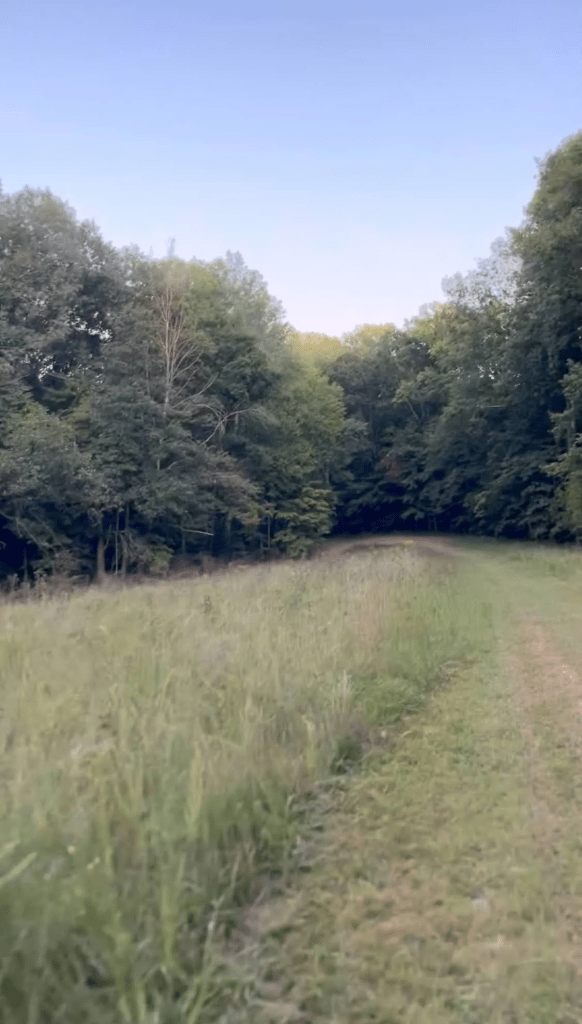
I didn’t know how this place could ever feel, or look, good again. I felt horrible for the trees. They lost their leaders. They lost the giants who protected and guided them. I felt bad for the meadow because it was torn to hell. The long blades of wild grasses blowing in the wind always made me feel like I was in a movie when I was walking down the lane.

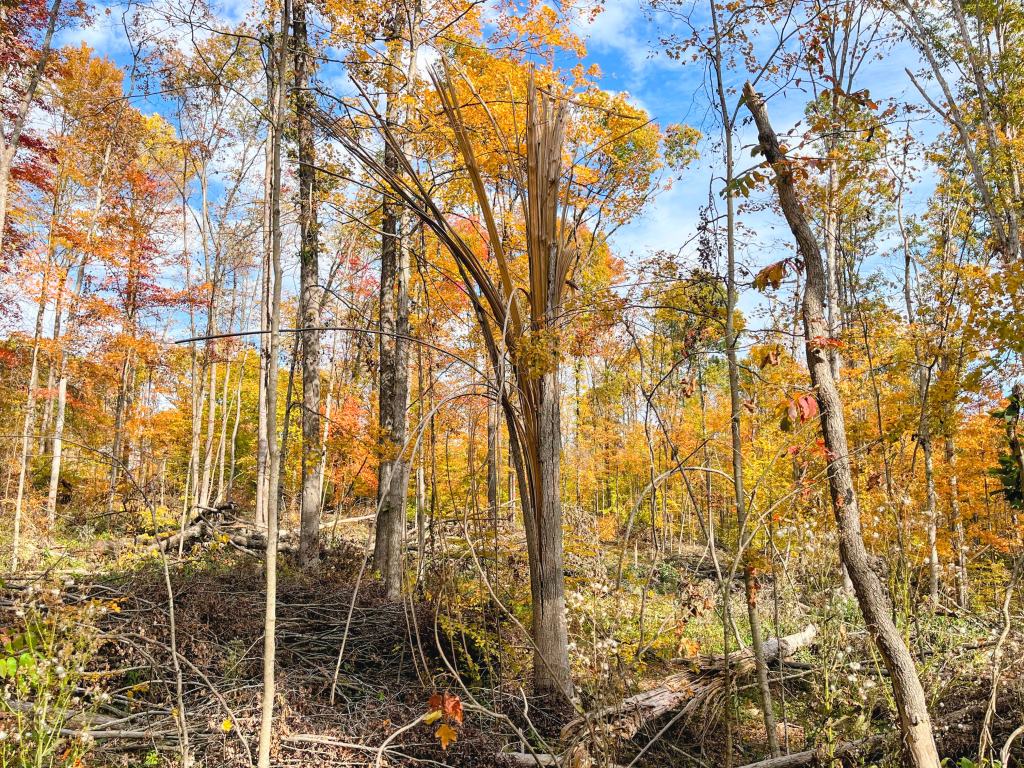
Then a few weeks later, the worst storm in over 60 years blew through. Our newly open tree canopy created vast empty space for the high winds to rip/bend/twist/mangle trees. I wanted to puke. I screamed so loud the entire county could hear my guttural shrieks. I cursed in utter defeat. I thought it was punishment for getting the area logged. I didn’t want to go there anymore. I avoided most of the property for 5 months. It’s like seeing your loved ones mangled right in front of you. I only saw pain, darkness, and negativity. My eyes were only drawn to the ugly, rotting mess littering the forest floor. I couldn’t see the beautiful green canopy that still remained. I didn’t stare long enough to see the blades of grass poking through the clay dust.

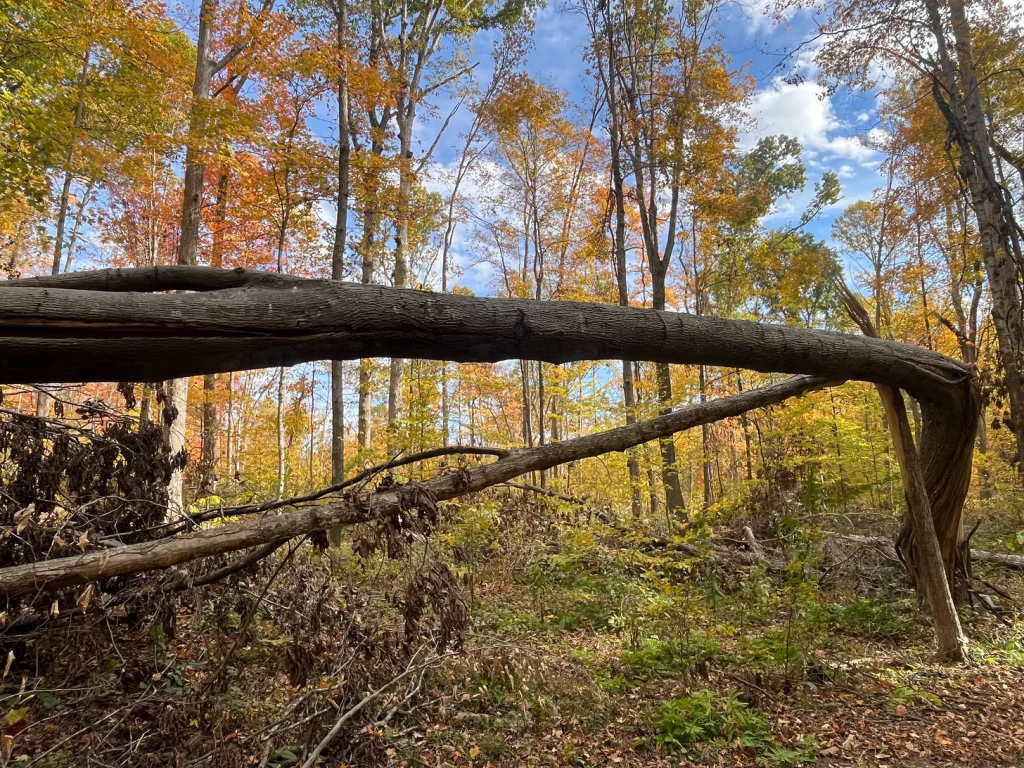
This used to be my favorite spot. It was filled with massive trees and the canopy was 100% full. It was breathtaking. It enveloped me in the most beautiful dappled shade. The first picture with the tree wrapped around another tree is about 50 feet to the left of this tree, which I have now dubbed as String Cheese. What are we even supposed to do with these? They are a death trap for novices like us to try to remove. We definitely would have to hire someone, but we can’t afford it. There are acres of forest like this!

I remember the first day that I spent time there. I was alone and bored, so I hiked. My husband had been working like crazy to clean the place up, but with a full time job and no help from me, it was a slow process. I decided to walk over to my sacred space and see if I could just be with it. To my amazement, I spent an hour there…the blazing orange fall leaves and cool temps definitely helped.

I stood in awe. These two massive trees that are broken beyond repair and normally an eye sore captured me. I couldn’t help but admire them. They have significant battle wounds that they can’t come back from. No tree envies the state they’re in. But aren’t they something? It’s hard to look away. They force you to envision the tremendous amount of wind that took their strength away. They are proof that nature can be a beast and it doesn’t discriminate. It literally chewed them up and spit them out. There was nothing they could do to prevent it from happening.

However, they are magnificent and unique, even in death. They will always remind me of the year that nearly broke me. They will be the perfect reference point to remind me of how far I’ve come in life. I hit rock bottom the exact time that they were being torn to shreds.

With the giants gone, the others have taken advantage and grown more than I thought possible. Their beauty this fall has brought peace to my soul and allowed optimism to creep in. It looks like the forest can breathe, whereas before everything seemed stifled and set. There wasn’t enough light or nutrients for new trees to grow big and strong. Now there is empty space everywhere for new growth. The tree tops left behind by the loggers, while ghastly to look at, have created an enormous influx in wildlife. I have never seen and heard so many animals!

Isn’t life just like that?

We feel grounded and strong, then life comes along and rips us out of our comfort zone. It knocks us down, leaves a mess at our feet, kills our loved ones, and leaves us with permanent scars. But we find others along the way that make the journey bearably beautiful. We find space to share with others who have also experienced pain. We share nutrients and support with others. We bend and bow, but always grow upwards. We grow together and build an entirely new canopy. It’s not better or stronger than the one the giants occupied. It’s its own thing. It experienced horrific devastation and loss, but chose to keep growing anyways.